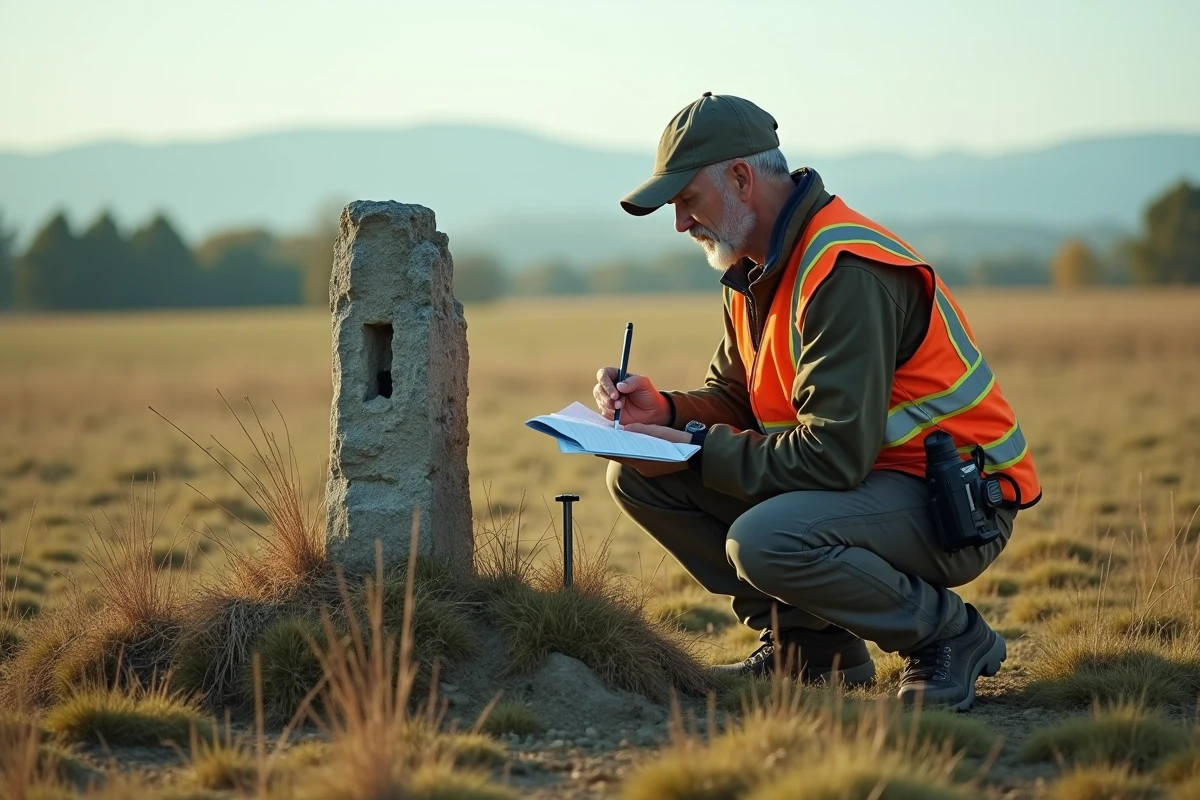
A missing boundary marker does not erase the property line. However, any attempt to reinstall it without professional intervention may incur civil or criminal liability for those who take the risk. In France, the Urban Planning Code reserves this restoration for a sworn professional.
Boundary markers have no immunity. A construction site, a collapsing fence, a change of ownership… and the marker can disappear without a sound, erased by machinery, absorbed by vegetation, or moved during a neighborhood dispute. Some, convinced they are in the right, even pull the marker out by hand, unaware of the consequences. Time also adds to the corrosion: roots, weather, erosion, everything works to erase the slightest trace.
The neighboring plot then becomes equally fragile. How far does the property extend? With a faded marker, certainty evaporates quickly. A disappearing boundary means the balance of the area crumbles: trust wavers, doubts settle in, and tension skyrockets. At the slightest uncertainty about the land, neighborhood conflicts multiply, jeopardizing the serenity of property owners and the legal security of any project.
In these circumstances, the restoration of missing boundary markers acts as a bulwark against arbitrariness. This process restores to each owner the certainty of their property’s outlines, secures any sale or construction, and locks in the division with an indisputable basis.
When the marker disappears: causes, consequences, and risks
Placing a marker signifies a separation between two properties. However, a plot’s life is far from static. Here are the most common situations where a marker ends up disappearing:
- work using construction machinery, which removes the marking without even realizing it
- the reconstruction or installation of a new fence, often synonymous with the displacement or removal of the marker without prior thought
- a disgruntled neighbor or resident moves or removes the marker, triggering a legal standoff afterwards
- the effects of time: rain, root growth, accumulation of soil or leaves, gradual erosion of the land
Once the marker is no longer visible, uncertainty sets in. Where does their land start and stop? This ignorance affects not only daily life: imprecision blocks projects, hinders a sale, or complicates inheritance. Sometimes, the disappearance of a marker leads to a legal dispute. Ambiguity is fertile ground for contestation and disagreement.
Restoring the boundary: the expertise of the land surveyor
A disappeared physical boundary cannot be reconstructed in a couple of shovel strokes or by a simple neighborly agreement. Only the independent and sworn land surveyor has the expertise to analyze, reconstruct, and materialize the forgotten boundary. This begins with a meticulous study of the archives: cadastral plans, property titles, old minutes. All pieces of the puzzle are examined.
Then, on-site, the land surveyor conducts a precise survey and compares the actual situation to the documents. This technical investigation leads to an indisputable delineation, constructed with rigor and neutrality. Two procedures exist depending on the context: amicable boundary marking (in case of agreement between owners) or judicial boundary marking (if discord is total). In both cases, a boundary marking report seals the new materialization. This official document, signed by each party, constitutes a lasting commitment.
By entrusting the restoration of boundaries to a professional, one obtains:
- a neutral expertise that is enforceable against all
- an analysis based on evidence and not mere impressions
- legal security rooted in law and practice
The land surveyor thus acts as an insurance policy: they protect every project, sale, new construction, or parcel division, and calm the neighborhood by ending ambiguities.

Budget, regulations, and precautions to ensure the integrity of your land
Engaging an expert comes at a cost. The fee depends on the area, the complexity of the configuration, the number of markers to be placed, and the volume of archives to study. Fees generally start at a few hundred euros and increase according to the specifics of the land. It is better to invest in a solid procedure than to face the legal consequences of uncertain boundary marking.
On the legislative side, the rule is strict: no one can move or install a marker without qualification. Only the land surveyor has the legal right to materialize boundaries. In case of a dispute, the judicial court rules based on the professional’s opinion. Removing or moving a marker can expose one to severe legal penalties; informed property owners always respect the procedure to avoid a boomerang effect.
To prevent any doubt about the delimitation, it is advisable to adopt certain good reflexes:
- systematically require a boundary marking report established by a land surveyor during sale, division, or construction
- cross-check cadastral plans, property titles, and on-site observations before any operation
- avoid building a fence or wall without regular boundary marking to prevent future disputes
- update the cadastral plan after any significant modification of the land
A piece of land with restored boundaries according to the rules is a closed door to conflicts, a property that gains clarity, and the prospect of projects carried out smoothly and without ulterior motives. Nothing replaces the serenity of a rediscovered boundary.