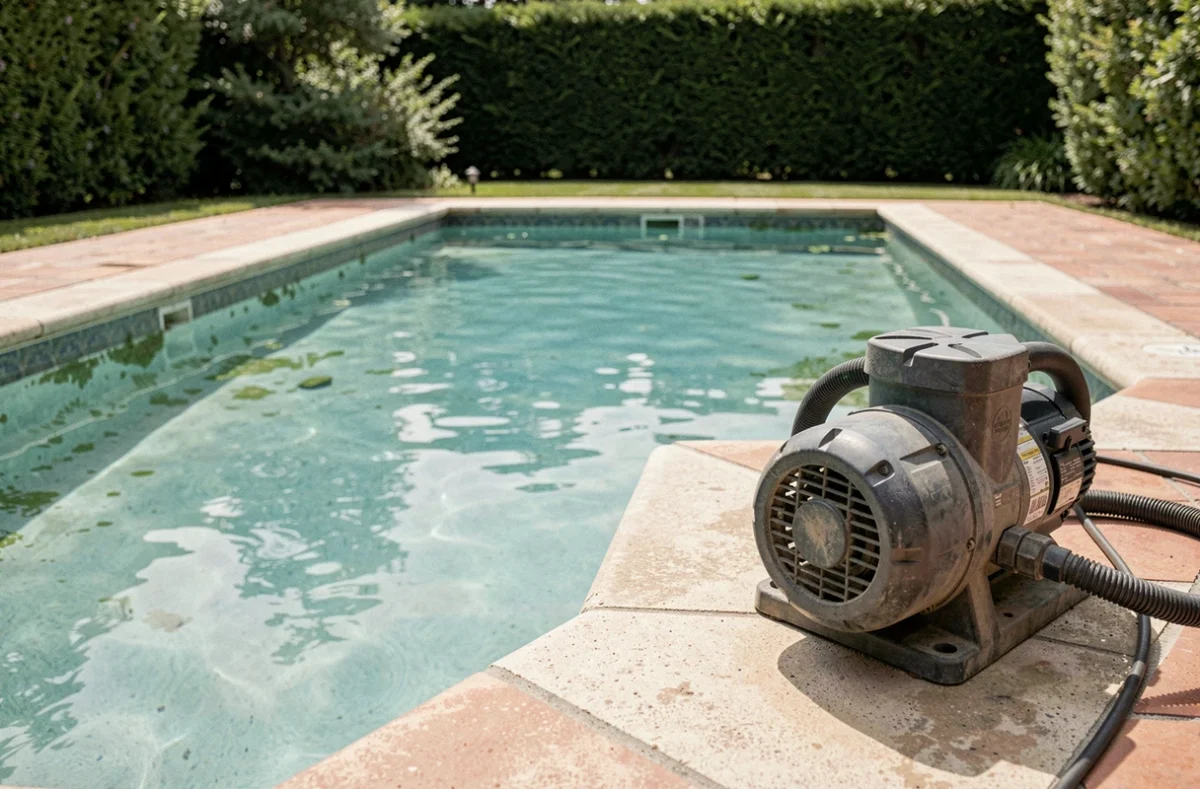
A pool pump does not just circulate water: it feeds the filter and, in the case of a salt electrolyzer, it also allows for the production of chlorine. Therefore, turning off the pump means simultaneously stopping both filtration and active disinfection of the pool. The duration for which the water remains safe depends on the level of residual disinfectant, the temperature, and the organic load present at the time of the shutdown.
Stagnation and dead zones: what happens in the pool without circulation
As soon as the pump stops, the water ceases to be stirred. The disinfectant still present is no longer distributed evenly. Dead zones appear in corners, steps, and nooks that are little exposed to the current, where the concentration of free chlorine drops faster than elsewhere.
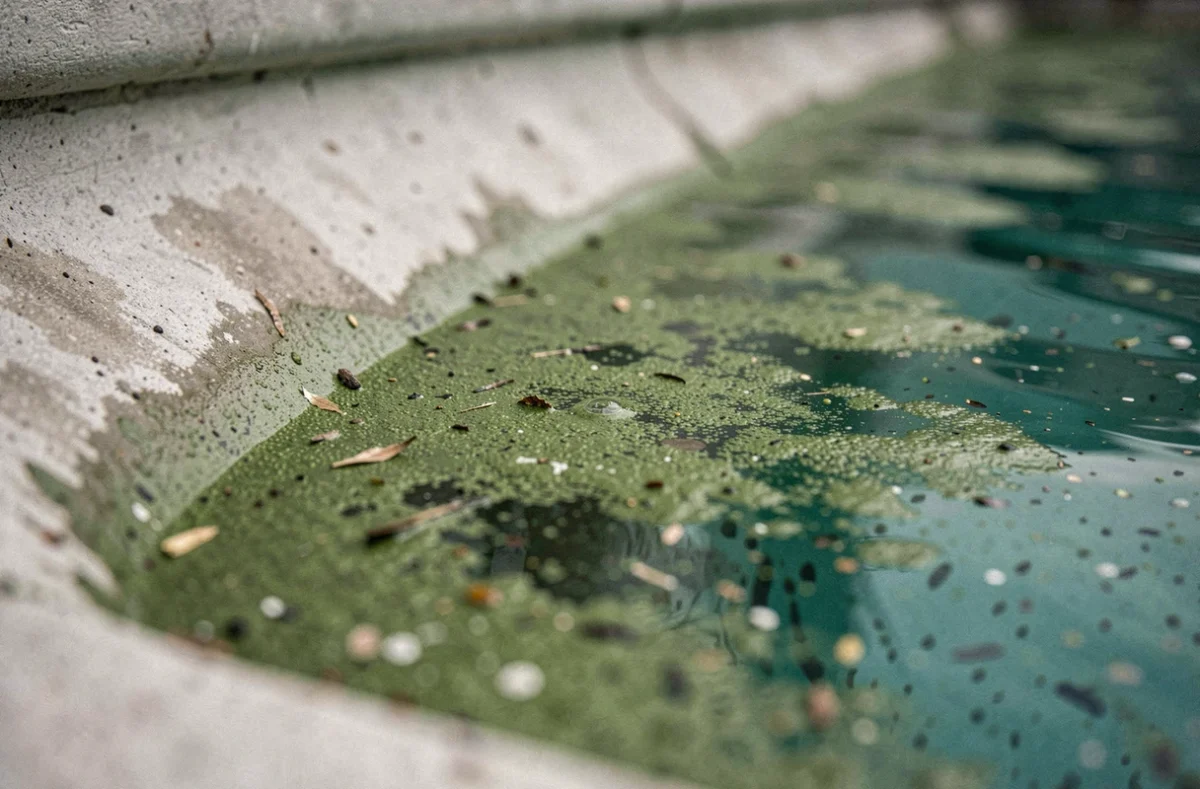
In these stagnant pockets, microorganisms find a favorable environment. Green algae, in particular, first colonize these areas before spreading to the rest of the volume. The water may still appear clear on the surface while the bottom of the pool is already beginning to degrade.
This phenomenon accelerates with heat. The higher the water temperature rises, the faster chlorine degrades under the combined effects of UV and heat, and the more bacteria multiply. In the height of summer, a sun-exposed pool without a cover loses its disinfecting power much faster than a shaded or covered pool. To learn more about La Petite Maison dans la Prairie, the temperature factor remains the most underestimated parameter by pool owners.
Pool without pump: the role of residual disinfectant in safety duration
The real question is not “how many days without a pump” but “how much disinfectant remains in the water.” The CDC recommends a minimum of 1 ppm of free chlorine for a residential pool, with a pH maintained between 7.0 and 7.8. In the presence of cyanuric acid (stabilizer), this threshold rises to 2 ppm.
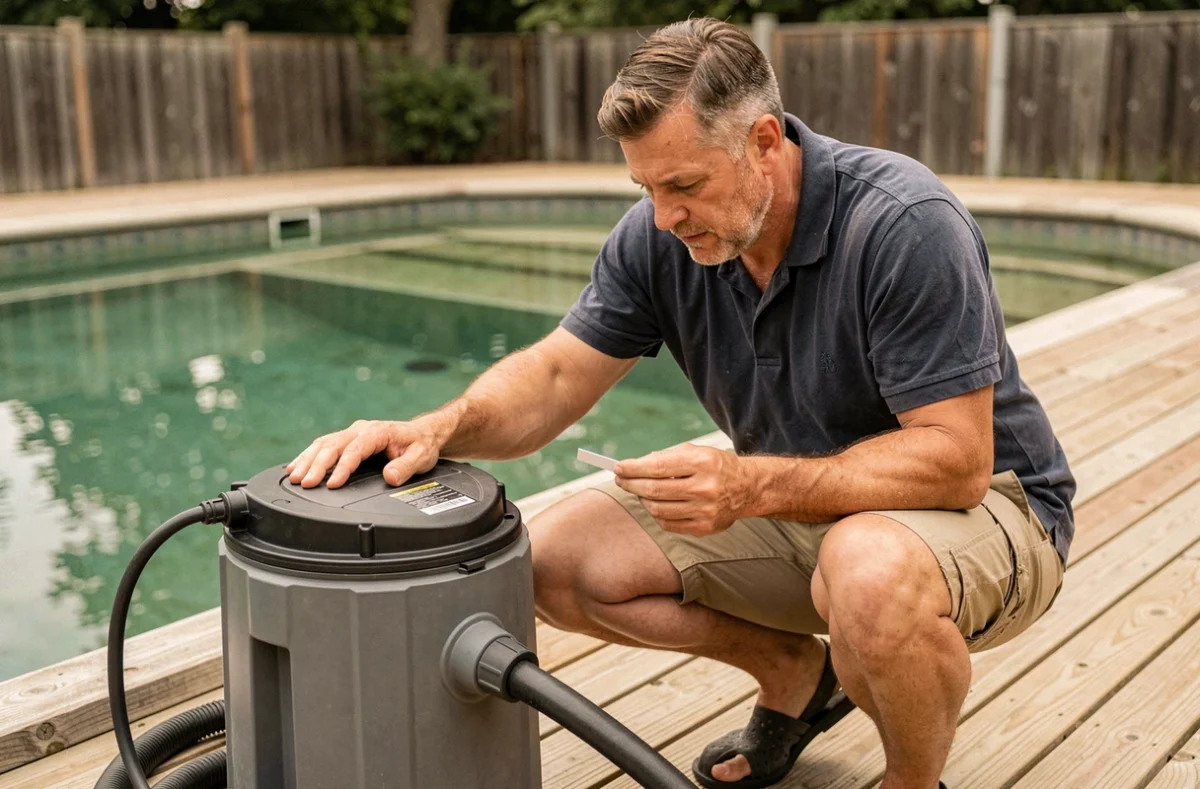
Water that has been properly treated just before the pump stops has a reserve of disinfectant. This reserve gradually depletes at a rate that depends on three main variables:
- The water temperature: above 28 °C, chlorine degradation accelerates significantly, reducing the safety window to just a few days at most.
- Direct sunlight: UV rays destroy free chlorine. An opaque cover or roller shutter significantly slows down this loss.
- The initial organic load: leaves, insects, sunscreen, sweat consume chlorine. A cleaned pool before shutdown retains its disinfectant longer than a pool loaded with debris.
Visually clear water does not guarantee disinfected water. Greening is a late symptom. Before the color changes, the chlorine level may have already fallen below the health safety threshold.
Salt electrolyzer and pump failure: a double cut often overlooked
Salt pool owners sometimes forget a technical detail. The electrolytic cell produces chlorine only when water circulates through it. Without a pump, the production of disinfectant stops abruptly, just like for a pool treated with traditional chlorine, but without the possibility of compensating with a tablet in the skimmer.
In practice, a salt system without circulation behaves like any untreated pool. The reserve of chlorine already dissolved in the water is the only barrier, and it depletes according to the same rules described above.
For planned absences of several days, placing a slow-release chlorine tablet in the skimmer or a floating dispenser allows for maintaining a minimal supply of disinfectant even without circulation. This is not a sustainable solution, but it significantly extends the safety window.
Restarting the pump after a prolonged shutdown: steps not to skip
Restarting the pump after several days of shutdown is not just a matter of pressing a button. Running a pump dry, even for a few minutes, can damage the mechanical seal and reduce its lifespan.
Before restarting, a precise sequence limits damage:
- Check that the skimmer and pre-filter baskets are clean, free of leaves or debris that could block the flow.
- Re-prime the pump if necessary (fill the pre-filter with water to avoid running dry).
- Clean or rinse the filter (sand, cartridge, or diatomaceous earth) before restarting circulation, as a clogged filter will reduce the effectiveness of the restart.
- Test the pH and free chlorine level with a reliable testing kit before any swimming. If the chlorine is below the recommended threshold, perform a shock treatment and wait for the parameters to return to the normal range.
The return to swimmable water must be confirmed by chemical analysis, not by appearance. Clear water after a shock treatment may still have an unbalanced pH or a chlorine level too high for swimming.
Preparing your pool before an absence: important actions
Rather than seeking a theoretical maximum duration, it is better to prepare the pool to withstand as long as possible without circulation. A thorough cleaning of the bottom and walls reduces the organic load. Adjusting the pH to the lower range (around 7.2) optimizes the effectiveness of the remaining chlorine.
Installing a thermal cover or a shutter limits evaporation, the influx of external debris, and chlorine degradation from UV rays. This simple action can double the duration during which the disinfectant remains above the safety threshold.
For absences exceeding a week in hot weather, the most reliable solution remains to entrust monitoring to a neighbor or a professional capable of checking the parameters and restarting the pump if necessary. No preventive treatment can indefinitely replace active filtration.