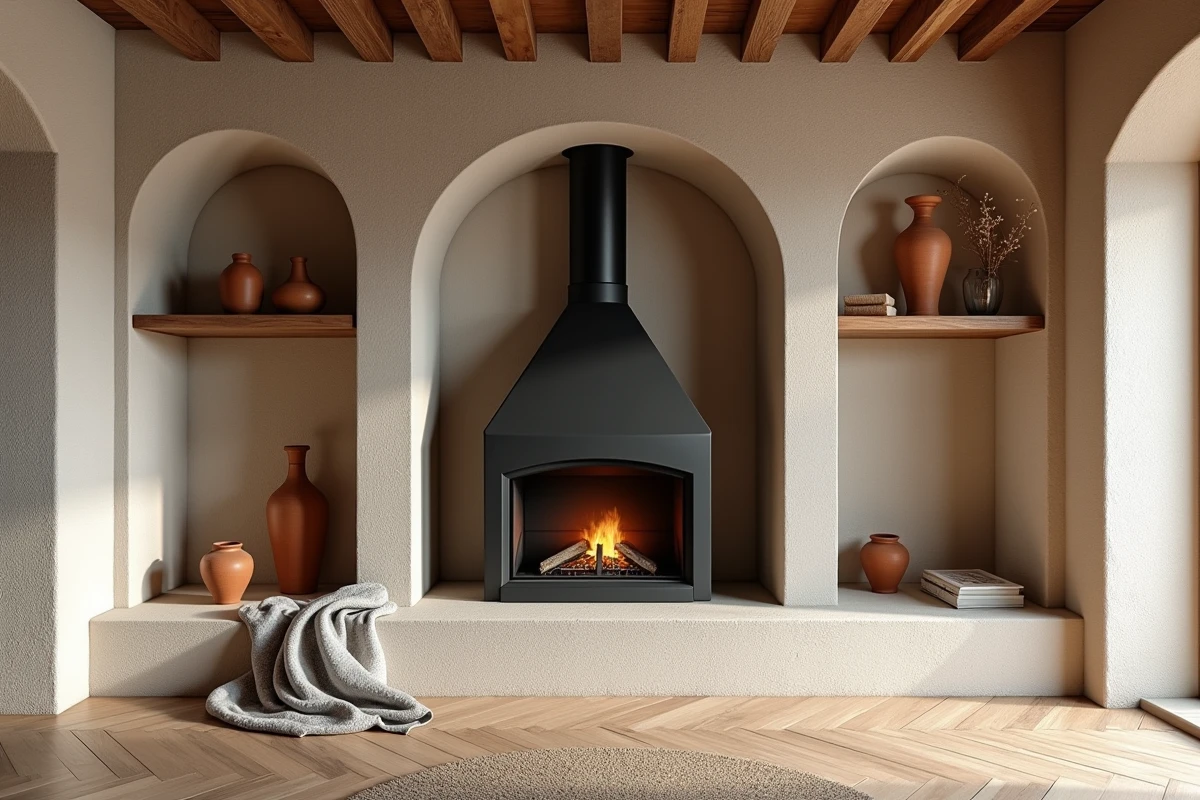
The cantou, this large alcove fireplace typical of homes in the southwest and Limousin, poses a concrete problem when opening up living spaces: sound rushes in, bounces off the stone, and creates bothersome reverberation. Modernizing a cantou is not just about changing the cladding. It requires rethinking the acoustics, ventilation, and materials so that this ancient niche functions in a contemporary interior.
Cantou and acoustics in an open space: the problem that no one addresses
Have you ever noticed that sound carries differently in a room with a large stone fireplace? The deep niche of the cantou acts like a soundbox. In a compartmentalized house, the effect remains subtle. As soon as a wall is knocked down to create an open living-kitchen area, the reverberation becomes noticeable.
Raw stone amplifies this phenomenon. The smooth, concave walls reflect sound waves back to the center of the room. The result: conversations become muddled, the television echoes, and acoustic comfort declines.
An interior lining made of absorbent material reduces the reverberation of the cantou without masking the stone. Craftsmen in Corrèze and Limousin use bio-sourced sheep wool for partial lining of the side walls. This material breaks sound reflection thanks to its fibrous structure while improving thermal comfort.
The initial extra cost is real, but feedback from craftsmen on renovations in 2025 in Corrèze-Limousin confirms a net gain in comfort.
To delve deeper into the layout and modernization techniques for the cantou, several approaches combine acoustic treatment and contemporary aesthetics.
Another option: install dense felt or cork panels on the upper part of the niche, where the voice bounces the most. These materials come in neutral shades that blend well with a stone decor.
Stainless steel flue and DTU 24.1 standard: the regulatory constraint to integrate above all
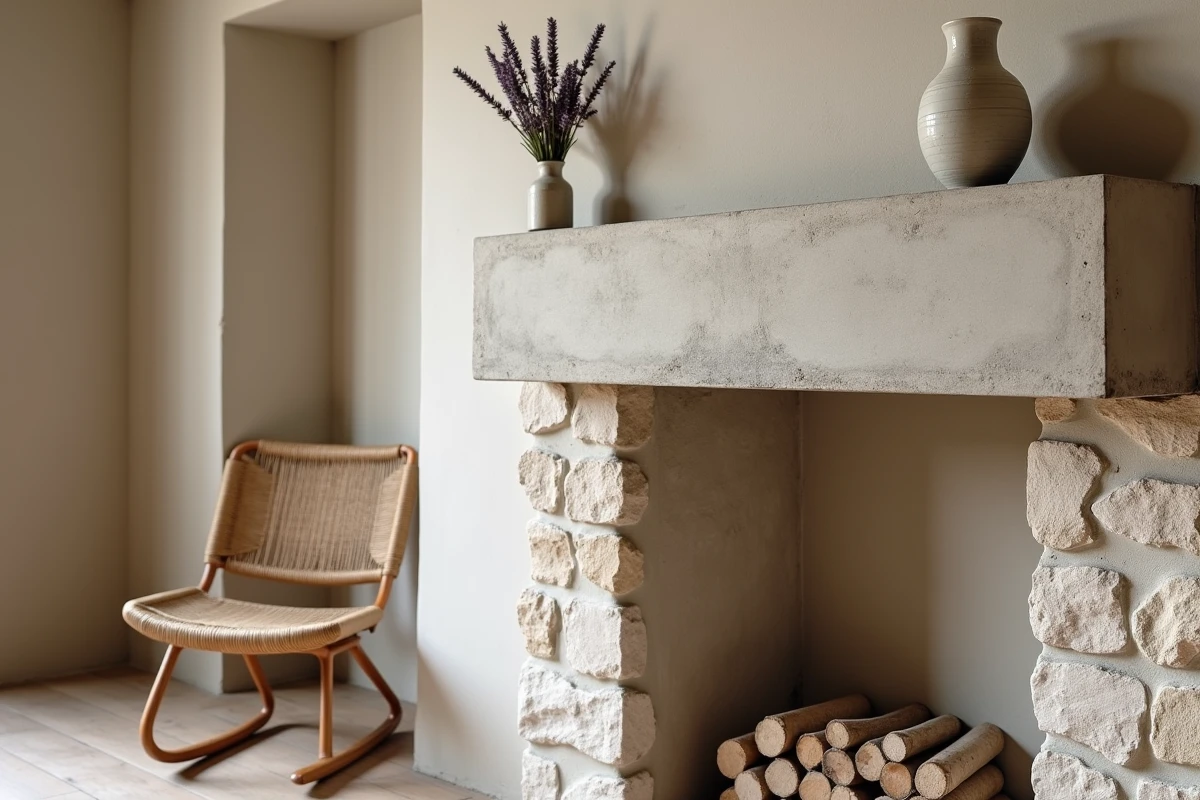
Before thinking about color or decoration, an existing cantou must go through a technical stage. Since the decree of January 15, 2025, the NF DTU 24.1 certification applies to all work on smoke ducts of existing cantous. In practical terms, this requires a stainless steel flue to prevent fire risks.
This obligation changes the budget landscape. The flue is not an aesthetic choice; it is a legal prerequisite. If you plan to keep a functional fireplace (wood or insert), have a diagnosis of the flue done first.
What the flue entails for the layout
The installation of the flue may require access from the top of the niche. If you had planned to install decorative cladding or shelves in the upper part of the cantou, schedule them after the flue installation to avoid dismantling everything.
- Engage a certified chimney specialist before any other trades. The diagnosis conditions the feasibility of the rest.
- Plan for an accessible inspection hatch, even behind a cladding. Regulations require it for future maintenance.
- If the flue is irrecoverable, the alternative is to seal the fireplace and transform the cantou into a purely decorative space, without combustion.
Cladding the cantou: wood, paint, and beams in a current decor
Once the technical question is settled, the choice of cladding materials sets the tone. The traditional cantou combines exposed stone and dark beams. Lightening the beams instead of painting them white preserves the wood’s texture while gaining brightness.
The most common method is to sand the beams to remove varnish or accumulated soot, then apply a clear stain (honey or bleached oak shade). The effect is immediate: the room appears taller and brighter, without losing its rustic character.
Painting the stone or leaving it raw
Painting the interior stone of the cantou white or light gray works well in a contemporary living room. Caution: a breathable mineral paint is essential on old stone. Traditional acrylic paints trap moisture and cause peeling within months.
If the stone is beautiful (golden limestone, sandstone, schist), leaving it raw and simply cleaning it with a matte water-repellent treatment often remains the best choice. Recessed lighting in the upper part of the niche is enough to highlight the material.

Pellet insert or decorative space: two directions for the modernized cantou
The cantou offers sufficient volume to accommodate a high-performance pellet insert. Compared to a traditional open fireplace, a pellet insert improves thermal efficiency and reduces particle emissions. Ductable models distribute heat to adjacent rooms, compensating for the loss of compartmentalization in open spaces.
The UFC-Que Choisir study of 2026 on wood heating notes that Scandinavian corner stoves (like Swedish kakelbaden) are gaining ground in rural French renovations since mid-2025, thanks to more uniform heat distribution. For a cantou, the ductable insert offers a compromise: it retains the charm of the niche while approaching the performance of these Nordic alternatives.
Transforming the cantou into a storage or reading space
If the fireplace is sealed, the volume of the cantou becomes an asset. Here are some concrete ideas:
- A masonry bench with thick cushions transforms the alcove into a reading nook. The “cocoon” effect works particularly well in large open living areas.
- Raw wood shelves, fixed into the side walls, create a built-in library. The stone background adds visual depth.
- Indirect lighting (warm white LED strip, placed on the upper cornice) is enough to transform the atmosphere without heavy work.
The modernized cantou does not need to sacrifice its identity to fit into a trendy space. The stone, beams, and depth of the niche are rare assets in contemporary architecture. Treating them with suitable materials (bio-sourced insulation, mineral paints, lightened wood) and respecting regulations on ducts allows the soul of the place to be preserved while gaining in acoustic and thermal comfort.